Service Dog Tasks and the Public Access Test, Explained
This page explains the law in general terms. It is not legal advice. For a specific situation, contact the agency listed on this site or an attorney.
Two ideas come up again and again when people talk about service dogs: the tasks the dog performs, and the public access test. They are related, but they are not the same thing, and neither one is a license or a certificate.
This guide explains what counts as a task under the ADA, gives examples by disability, and shows how to train toward the public access test as a benchmark. It also covers what Virginia law says about service dogs in public places. It is written for handlers, family members and owner-trainers in Virginia.
What counts as a service dog task
ADA.gov defines a service animal as a dog individually trained to do work or perform tasks for an individual with a disability. The task must be directly related to the person's disability.
That wording has two parts. The dog is individually trained, which means the dog was taught a specific behavior on purpose. The behavior also has to connect to the handler's disability. A dog that is simply well behaved, or simply loved, does not meet the definition by those traits alone.
Virginia uses a similar idea. Section 51.5-40.1 of the Code of Virginia defines a service dog as a dog trained to do work or perform tasks for a mobility-impaired or otherwise disabled person. The same section says emotional support, well-being, comfort or companionship does not count as work or tasks.
Examples of tasks by disability
The ADA does not publish a closed list of approved tasks, and neither does the Virginia Code. The examples below show the kind of work that fits the definition. A person's actual tasks depend on their own disability and needs.
Mobility disabilities
- Retrieving dropped items such as keys, a phone or a cane.
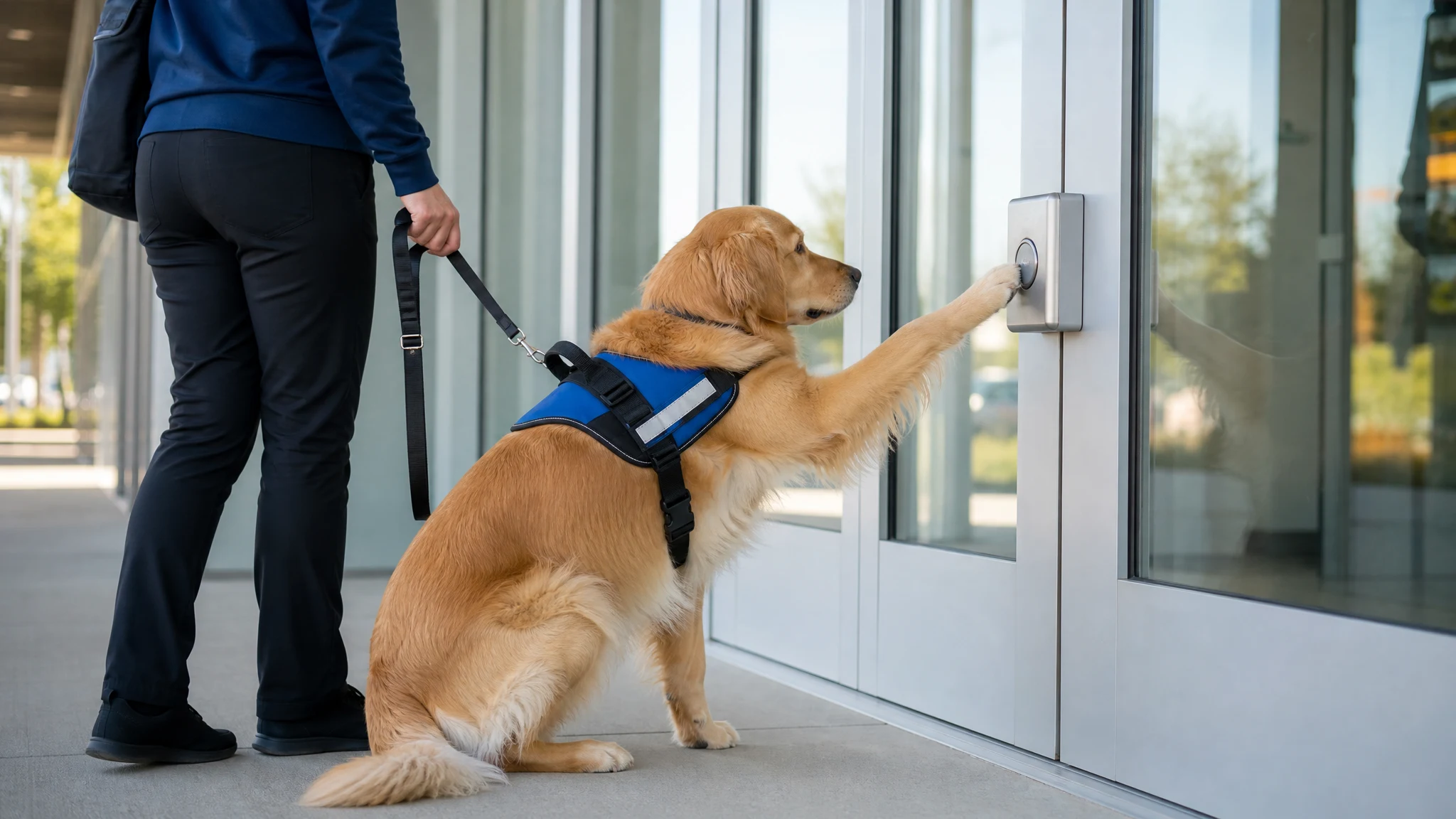
- Opening doors or pressing automatic door buttons.
- Providing bracing support while the handler stands up or steps over a curb.
- Pulling a manual wheelchair or helping with transfers.
Seizure disorders and medical conditions
- Staying with the handler during a seizure and getting help, if trained to do so.
- Alerting the handler to a change tied to a medical condition, such as low blood sugar, when the dog has been trained to give a specific signal.
- Fetching medication or a phone.
Psychiatric and PTSD-related disabilities
- Interrupting repetitive or self-injuring behavior with a trained nudge or paw touch.
- Waking the handler from a nightmare.
- Turning on lights or checking a room on cue.
- Creating space in a crowd by standing in front of or behind the handler on cue.
Virginia does not have a statute on psychiatric service dogs by name. The state definition covers any otherwise disabled person, which includes a person with a mental illness. The federal ADA definition applies as well.
Autism
- Interrupting a harmful behavior pattern.
- Staying with a child and helping prevent bolting when a handler uses a trained tether or hold-and-stay routine.
- Applying calming pressure on cue, when it is a trained response and not just the dog's presence.
Several Virginia programs train dogs for these needs. Saint Francis Service Dogs in Roanoke lists autism, mobility and seizures among the needs it serves. Service Dogs of Virginia in Charlottesville lists autism, diabetes, mobility and PTSD among its areas.
Deafness and hearing loss
- Alerting to a doorbell, alarm, name call or approaching sound.
- Leading the handler to the source of a sound.
Virginia law also names the hearing dog, which it describes as a dog trained to alert its owner by touch to sounds of danger.
Blindness and low vision
- Guiding around obstacles and stopping at curbs and stairs.
- Finding doors, seats or crosswalk buttons.
Why comfort alone is not a task
Many dogs make their owners feel better. That is real and valuable. It is not, by itself, a task under the ADA.
Emotional support, therapy and comfort animals are not service animals under the ADA. The difference is training and function. A task is something the dog does on cue or in response to a specific trigger, and it can be described in a sentence. "Wakes me during a nightmare" is a task. "Makes me feel calm by being nearby" is comfort.
Virginia's definition in section 51.5-40.1 draws the same line by excluding emotional support, well-being, comfort and companionship from the meaning of work or tasks.
This distinction matters in public. Under the ADA, when a disability is not obvious, staff may ask two questions: whether the dog is a service animal required because of a disability, and what work or task the dog has been trained to perform. A handler who can clearly answer the second question is in the best position.
The public access test is a benchmark, not a legal requirement
The public access test is a training standard used by Assistance Dogs International (ADI), the accrediting body behind several Virginia programs. ADI lists accredited members in Virginia on its member search page. Programs such as Mutts With A Mission in Virginia Beach, Paws for Purple Hearts in Ruther Glen, Saint Francis Service Dogs in Roanoke and Service Dogs of Virginia in Charlottesville appear there as ADI accredited.
The test is used to judge whether a dog behaves reliably in stores, restaurants and other public settings. It is useful for owner-trainers because it gives a clear target.
It is not a legal requirement under the ADA. ADA.gov describes no registry, no required certification and no mandatory test. Passing a public access test does not create legal rights, and failing one does not remove them. Never describe an online registration, ID card or certificate as proof of legal status. Those products are not part of the ADA.
For the exact items and scoring in the current ADI standard, check with ADI or with an accredited program. Standards can be updated, so this article does not reproduce them.
How to train toward task reliability and public access
Materials needed
- A well-fitting flat collar or harness and a standard leash. Use a harness, backpack or vest that identifies the dog as a service dog, which Virginia Code section 51.5-44 refers to for a service dog in public places.
- Small, soft, high-value treats and a treat pouch.
- A clicker or a consistent marker word such as "yes."
- A mat or small blanket for settle practice.
- A notebook or phone to log tasks and practice sessions.
- Access to a variety of low-stress public places, used gradually.
All training should follow humane, reward-based methods, consistent with the American Veterinary Society of Animal Behavior (AVSAB). Do not use shock, prong or choke collars, alpha rolls, scruffing or dominance methods. They can cause fear and stress and can damage the working relationship.
Step 1: Write down each task in one sentence
Start with the disability-related need, then name the behavior. For example: "When I begin to stand, the dog braces so I can steady myself." A written task keeps training focused. It also gives you a clear answer if a business staff member asks what the dog does.
Step 2: Build the foundation behaviors
Before any task, teach attention, sit, down, stay, loose-leash walking, a settle on a mat and a reliable recall. Practice at home first, in short sessions. End on a success.
Step 3: Teach each task in small pieces
Break the task into steps and reward each one. To teach a retrieve, for example, reward looking at the object, then touching it, then picking it up, then holding it, then bringing it to you. Add a cue only after the behavior is dependable. Then add distance, distractions and new locations, one change at a time.
Step 4: Practice the task in the real situation
A task taught in the living room may fall apart in a parking lot. Rehearse where the task is actually needed, such as a doorway, a curb or a store aisle. Raise difficulty slowly.
Step 5: Introduce public places gradually
Begin outside, then visit quiet indoor places during off-peak hours. Reward calm behavior and keep sessions short. If the dog shows signs of stress, such as panting, lip licking, refusing food or pulling away, move back to an easier setting. A dog can leave a session early without that being a failure.
Step 6: Work the public access skills
Practice the skills commonly expected of a dog in public. Those include:
- Walking on a loose leash through crowds and doorways.
- Settling under a table or beside a seat.
- Ignoring dropped food and passing people or other animals.
- Staying calm around noise, carts and sudden movement.
- Waiting while the handler does a task, such as paying.
- Staying clean, quiet and under control.
Check ADI or an accredited program for the current test items so your practice lines up with the real standard.
Step 7: Run a mock test with a helper
Ask a trusted friend to watch and score a practice run. Use a place you have already visited. Take notes on what went well and what needs more work. Repeat the mock test on different days and at different locations.
Step 8: Keep maintaining
Reliable behavior fades without practice. Keep rewarding good work, review tasks regularly and watch for stress, pain or fatigue in the dog.
Virginia rules to know
Section 51.5-44 of the Code of Virginia gives persons with disabilities the right to be accompanied by a trained guide dog, hearing dog or service dog in the public places and accommodations listed in the statute. A hearing dog wears a blaze orange leash. A service dog wears a harness, backpack or vest identifying it. The handler does not pay an extra charge for the dog, but is liable for any damage the dog does to the premises or facilities.
The statute also covers dogs in training. Under section 51.5-44(E), a person accompanied by a dog in training that is at least six months old may have access under conditions. These include being an experienced trainer, conducting continuing training, or being part of a three-unit service dog team. A service dog in training must wear a harness, backpack or vest identifying it. Read the statute for the full conditions before relying on it.
Section 51.5-44.1 makes it a Class 4 misdemeanor to knowingly and willfully fit a dog with a harness, collar, vest or sign to fraudulently gain public access for it as a service dog or hearing dog. Check the statute or the Attorney General's office for the penalty amount.
For housing, Virginia Code section 36-96.3:1 covers assistance animals in a dwelling. It says a resident with an assistance animal cannot be charged a pet fee, deposit or additional rent, and that a provider may ask for reliable documentation of the disability and the disability-related need. Workplace questions fall under section 51.5-41, which requires reasonable accommodation for known impairments. That page does not mention service dogs specifically, so ask the agency below about a specific situation.
For a broader look at training routes, program options and costs, see our guide to service dog training in Virginia, including laws, programs and costs.
Tips and common mistakes
Tips
- Train one task at a time. Add the next only when the first is dependable.
- Keep a written log. It shows progress and helps you spot patterns.
- Practice short, frequent sessions in many locations.
- Pay attention to the dog's body language and welfare.
- Ask an accredited program or a qualified trainer for help if a behavior is stuck.
Common mistakes
- Counting comfort as a task. If the only function is emotional support, the dog does not meet the ADA definition.
- Paying for registration or certificates. These are not required and are not legal proof.
- Rushing into crowds. Too much too soon can create fear and set training back.
- Treating the public access test as a legal pass or fail. It is a benchmark for training.
- Using harsh corrections. Aversive tools and dominance methods can harm the dog and the working bond.
- Keeping a dog in public when it is stressed. The handler's responsibility is to keep the dog under control and to leave when needed.
What results to expect
With patient, consistent, reward-based practice, many teams find that tasks become more reliable and that the dog settles better in public. Progress varies a great deal between dogs and handlers. Some dogs take many months, and some are not suited to public work. A dog that is not a good fit can still be a loved pet. Results cannot be promised, and an honest assessment of the dog is part of the process.
Where to take a complaint
This article states the law in plain terms and is not legal advice. If you believe your rights have been denied, the Office of Civil Rights in the Office of the Attorney General of Virginia takes disability complaints about places of public accommodation, employment, education and real estate. Housing complaints go to the Virginia Fair Housing Office at 804.367.8530.
Sources
- ADA.gov, Frequently Asked Questions about Service Animals and the ADA
- Code of Virginia, 51.5-40.1 (definitions)
- Code of Virginia, 51.5-44 (rights of persons with disabilities)
- Code of Virginia, 51.5-44.1 (fraudulent representation)
- Code of Virginia, 36-96.3:1 (assistance animals in housing)
- Code of Virginia, 51.5-41 (employment)
- Virginia Office of the Attorney General, Civil Rights
- Assistance Dogs International, Virginia member search