How to Owner-Train a Service Dog in Virginia: A Step-by-Step Plan
This page explains the law in general terms. It is not legal advice. For a specific situation, contact the agency listed on this site or an attorney.
Many people with disabilities train their own service dogs. It is legal, it is common, and it takes far more time and structure than most people expect. This guide walks through how to train a service dog yourself, stage by stage, and ties each stage to what Virginia law says about dogs in training.
The law is described here in plain terms and is not legal advice. Where the details matter, the guide points you to the statute or agency that decides them.
Key Takeaways
- The ADA does not require a service dog to be trained by a program. An owner trained service dog is covered if it is individually trained to do work or perform tasks directly related to your disability (ADA.gov).
- There is no official registry or required certification under the ADA. Online registrations and ID cards are not legal proof of anything.
- Virginia's Va. Code 51.5-44(E) extends public access to a dog in training that is at least six months old, but only under conditions listed in the statute.
- Emotional support alone does not make a dog a service dog under the ADA or under Va. Code 51.5-40.1. The dog must be trained to do work or tasks.
- Use reward-based methods only, in line with the American Veterinary Society of Animal Behavior (AVSAB). Bring in a professional trainer for task work.
Table of Contents
- What Virginia and Federal Law Say About Owner Training
- Stage 1: Temperament and Health Screening
- Stage 2: Foundation Obedience
- Stage 3: Socialization
- Stage 4: Task Training
- Stage 5: Public Access Work
- Your Rights, Your Limits and Where to Complain
- Getting Help and Knowing When to Stop
What Virginia and Federal Law Say About Owner Training
Start with the legal ground, because it shapes every later stage.
The federal definition
ADA.gov defines a service animal as a dog individually trained to do work or perform tasks for an individual with a disability. The task must be directly related to the person's disability. Nothing in that definition requires a particular trainer or program. That is why owner training is legal under the ADA.
The Virginia definition
Va. Code 51.5-40.1, in the Code of Virginia, defines a service dog as a dog trained to do work or perform tasks for a mobility-impaired or otherwise disabled person. The statute says emotional support, well-being, comfort or companionship does not count as work or tasks. It does not mention miniature horses.
The Virginia definition covers "otherwise disabled" persons. A person with a mental illness can fall within that wording. The Code of Virginia does not address psychiatric service dogs by name in the sections reviewed for this guide, so check the statute text or ask the agency listed near the end if your situation turns on this point.
No registry, no certificate
There is no official service dog registry or required certification under the ADA. Do not pay a website for a registration, certificate or ID card and treat it as proof. A vest can be useful for the public, but it does not create legal status. What counts is the dog's individual training and the work it does for you.
Emotional support is a different category
Emotional support, therapy and comfort animals are not service animals under the ADA. A dog that calms you by being near you is not performing a trained task. A dog trained to interrupt a panic episode by a specific behavior, or to apply pressure on cue, is a different matter, because that is trained work.
For a broader look at programs, costs and legal background in the state, see our guide to service dog training in Virginia: laws, programs and costs.
Stage 1: Temperament and Health Screening
Many owner-training efforts fail at the start, because the dog was never a good candidate. Screening protects you, the dog and the people around you.
Temperament
Look for a dog that is calm, curious and recovers quickly from surprises. Warning signs include fear of new people or places, reactivity toward other dogs, resource guarding, and high excitement that does not settle. These are hard to train away, and public work adds pressure on any dog.
You can start with a puppy or an adult. A puppy gives you control over early experiences but carries risk, since adult temperament and health are not certain. An adult dog lets you assess personality now. In either case, be honest about what you see.
Health and structure
Service work is physical. Ask your veterinarian about joint health, hips, elbows, eyesight, hearing and overall fitness for the work you have in mind. A dog that will brace or retrieve for a mobility handler needs a sound body. Breed-specific health testing recommendations vary, so ask a veterinarian and the relevant breed club rather than relying on a general list.
The Virginia link
Under Va. Code 51.5-44(E), a dog in training must be at least six months old to receive the in-training access provisions. Before that age, there is no in-training access under that subsection, so early work happens at home, in your yard, and in places that already allow dogs or that give you permission.
Honest questions to ask before going further
- Does this dog enjoy working with me, or does it tolerate it?
- Can I afford veterinary care, training help and equipment over two years or more?
- Can I handle the dog on my worst day? What is my backup plan?
- Is a program-trained dog a better fit? Washouts happen, and there is no shame in that.
Stage 2: Foundation Obedience
Foundation skills are the base for everything else. Plan on months of short, consistent sessions, not a weekend course.
Reward-based methods only
Use food, toys, praise and play to teach behaviors. This matches the approach recommended by the American Veterinary Society of Animal Behavior (AVSAB). Do not use shock collars, prong collars, choke collars, alpha rolls, scruffing or dominance methods. They carry welfare risks, and they can damage trust and make a working dog anxious, which is the opposite of what a service dog needs.
Core skills to build
- Name response and eye contact. Your dog should check in with you before anything else.
- Sit, down and stand. Teach each on a verbal cue and a hand signal.
- Loose-leash walking. No pulling, even past food and other dogs.
- Stay and release. Build duration, distance and distraction slowly.
- Recall. A reliable come when called, rewarded generously.
- Settle on a mat. The dog lies quietly for long stretches, including under tables and chairs.
- Leave it. The dog ignores dropped food and things on the floor.
- Handling tolerance. The dog accepts being touched, groomed and examined without stress.
How to run sessions
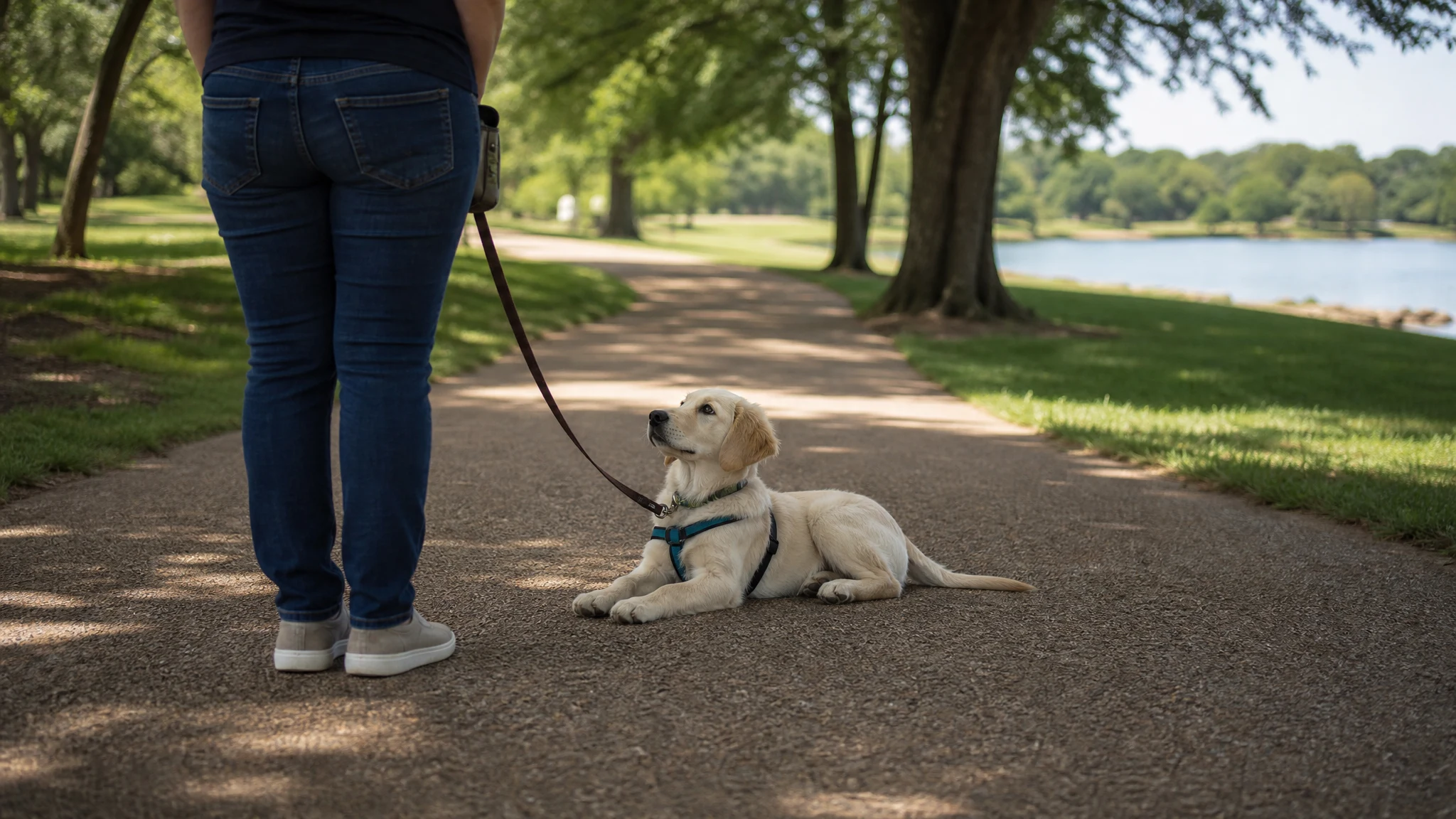
Keep sessions to a few minutes. End while the dog is still successful. Raise one criterion at a time: if you add distance, do not also add distraction. When the dog fails, make the task easier rather than correcting it.
The Virginia link
Va. Code 51.5-44(E) lists conditions for in-training access, and one is that the person is conducting continuing training. Solid foundation skills make that kind of outing realistic. A dog that cannot settle or walk politely is not ready for a public place, whatever the law allows.
Stage 3: Socialization
Socialization means building positive, calm experiences with the world. It does not mean letting your dog greet everyone. A service dog should be neutral about people, dogs and distractions.
What to expose your dog to
- Surfaces: tile, grates, carpet, elevators and slippery floors
- Sounds: traffic, sirens, carts, dropped objects, crowds
- People: children, people in hats, uniforms, wheelchairs and canes
- Vehicles: cars, buses, rideshares, and any transport you actually use
- Other animals, at a distance, with the dog ignoring them
How to do it well
Go at the dog's pace. Watch for stress signs such as lip licking, yawning, a tucked tail or turning away. If you see them, increase distance and slow down. Pair new things with treats so the dog connects them with good outcomes.
Begin in low-pressure spots such as a parking lot, then move to a quiet outdoor area and gradually to busier places. Always check that a location allows dogs, or get permission from the owner or manager before you bring a dog that is still in early training.
The Virginia link
Va. Code 51.5-44(E) sets a floor of six months of age for in-training access. It also requires that a service dog in training wear a harness, backpack or vest identifying the dog as a trained service dog. Introduce the gear early, at home, so wearing it feels normal and predicts good things.
Stage 4: Task Training
Task training is what separates a service dog from a well-behaved pet. Under the ADA, the dog must be individually trained to do work or perform tasks directly related to your disability (ADA.gov). Va. Code 51.5-40.1 uses the same core idea.
Choosing tasks
Tasks depend on your disability and your daily needs. Examples include retrieving dropped items, opening doors with a pull strap, bracing for balance, alerting to a sound, interrupting a harmful behavior, or applying deep pressure on cue. Your own treating clinicians can help you identify which tasks would actually help.
Presence, comfort and affection do not count as tasks. Under Va. Code 51.5-40.1, emotional support, well-being, comfort or companionship is expressly not work or tasks.
How tasks are taught
Most tasks are built from small behaviors using reward-based shaping and luring. A retrieve, for example, grows from a nose touch, to a mouth touch, to a hold, to a pickup, to a hand delivery. Each step is rewarded and made reliable before the next is added. Then you add cues, new locations and distractions.
Bring in a professional trainer
Task work is where a qualified professional helps most. A good trainer can assess whether a task is safe, whether your timing is clear, and whether the dog is learning what you think it is learning. Choose someone who uses only reward-based methods and who has experience with assistance work.
Be cautious about any trainer who promises a certified or registered dog, or who guarantees an outcome. No such certification is required under the ADA, and no one can promise how a living animal will turn out. Ask for a clear description of methods, and walk away if shock, prong or choke tools or dominance methods are part of the plan.
Keep a training log
Write down tasks, dates and progress. A log helps you see problems early and helps you answer the questions staff may ask in public. It is not a legal requirement, and it is not a certificate.
The Virginia link
The in-training provision in Va. Code 51.5-44(E) lists who may bring a dog in training into public places: an experienced trainer of guide, hearing or service dogs (or of the organization named on a jacket the dog wears), a person conducting continuing training, or a member of a three-unit service dog team conducting continuing training. How these conditions apply to an owner who is training their own dog is a question to settle by reading the statute itself and asking the Office of Civil Rights at the Office of the Attorney General of Virginia, listed below.
Stage 5: Public Access Work
Public access is where all the earlier stages come together. Go in small steps, and treat every trip as training.
A gradual plan
- Dog-friendly places first. Pet supply stores that welcome dogs, outdoor shopping areas and sidewalks.
- Quiet public places. Short visits at off-peak times, leaving before the dog tires.
- Busier places. Grocery stores, medical offices, restaurants, with tasks performed on cue.
- Complex settings. Public transport, crowds and long outings.
What good public behavior looks like
- The dog stays beside you and ignores people, food and other animals.
- It settles under a table or chair without fuss.
- It does not bark, sniff merchandise or pull toward distractions.
- It performs its tasks when needed, even in a distracting setting.
- It toilets only on cue and in appropriate places.
If the dog is struggling, end the outing and go back a step. Pushing a stressed dog is unfair to the dog and risky for you.
Gear
Va. Code 51.5-44 describes a service dog as accompanying its handler in a harness, backpack or vest identifying it. Plain gear works. Do not buy it from a site that sells registrations or certificates as if they were legal documents.
Virginia rules that apply once you are out
- No extra charge. Section 51.5-44 says a person may not be charged extra for the dog.
- Liability. The handler is liable for any damage the dog does to the premises or facilities.
- Places covered. Section 51.5-44(B) lists the public places and accommodations covered. Read it for the exact list.
The two questions
When your disability and the dog's role are not obvious, ADA.gov says staff may ask only two questions: whether the dog is a service animal required because of a disability, and what work or task the dog has been trained to perform. Prepare a short, calm answer to the second one. Staff may not ask for paperwork as a condition of entry under those two questions. See the ADA.gov FAQ on service animals for the full rules, including when a dog can be asked to leave.
Your Rights, Your Limits and Where to Complain
Misrepresentation
Under Va. Code 51.5-44.1, knowingly and willfully fitting a dog with a harness, collar, vest or sign to fraudulently gain public access for it as a service dog or hearing dog is a Class 4 misdemeanor. The fine amount is not stated here, so check the statute. This is another reason not to dress an untrained pet as a service dog.
Housing
Va. Code 36-96.3:1 covers rights and responsibilities for assistance animals in a dwelling. It provides that a resident with an assistance animal may not be charged a pet fee, deposit or additional rent. A housing provider may ask for reliable documentation of the disability and the disability-related need. Section 36-96.3 also bars refusing reasonable accommodations in rules, practices, policies or services.
Work
Va. Code 51.5-41 bars employers from discriminating against otherwise qualified persons with disabilities and requires reasonable accommodation for known physical and mental impairments. The section does not mention service dogs specifically, so ask the agency below about a workplace request.
Where to complain
The Office of Civil Rights at the Office of the Attorney General of Virginia takes disability complaints about places of public accommodation, employment, education and real estate. Housing complaints go to the Virginia Fair Housing Office, at 804.367.8530.
Getting Help and Knowing When to Stop
Support along the way
You do not have to do this alone. A reward-based trainer can coach you on foundation work and task design. Your veterinarian can monitor health and comfort. Virginia also has assistance dog organizations; our guide on service dog programs and costs in Virginia covers them. Check each program directly for eligibility, fees and waitlists.
When a dog is not suited to the work
Some dogs do not enjoy service work, and that is a valid result. Signs include persistent fear, reactivity, constant stress behaviors or an unwillingness to engage. Retiring a dog from training protects its welfare. It can remain a loved pet, and you can restart with a different dog or look at a program-trained dog.
A simple checklist
- Dog screened for temperament and health, and at least six months old before in-training outings
- Reliable foundation skills in many places
- Calm, neutral behavior around people and animals
- At least one task trained to be reliable and directly related to your disability
- Gear that identifies the dog, worn comfortably
- A short, calm answer to the two ADA questions
- Knowledge of the rules on liability, access and misrepresentation
Owner training is slow, and results vary from dog to dog. Take it one stage at a time, keep it positive, and get professional help when the work gets complex.